Cross-border guide
Employment
Managing a global workforce requires navigating complex and frequently changing employment laws. Our cross-border guide outlines the key aspects of employment law across multiple jurisdictions, helping organizations understand their obligations and manage employment issues with confidence.
Jurisdictions
Indonesia
Indonesia
Argentina
The content of this guide summarizes the position as at August 2026.
Indonesia
Some kind of longer intro text here to set the scene for the entire section, possibly drawing out some of the highlights from this region. Making a solid intro for the detail which follows below. Some kind of longer intro text here to set the scene for the entire section, possibly drawing out some of the highlights from this region. Making a solid intro for the detail which follows below.

Minimum age
Under the Manpower Law (Law No. 13 of 2003 regarding Manpower as amended several times by Law No. 6 of 2023 on the Stipulation of Government Regulation in Lieu of Law No. 2 of 2022 on Job Creation into Law (Job Creation Law) and Constitutional Court Decision No. 168/PUU-XXI/2023, employers are generally prohibited from employing children under 18. Law No. 1 of 2023 regarding Criminal Code (as amended by 1 of 2026 regarding Criminal Adjustment) has further harmonised the sanctions for such violations with the new Indonesian Criminal Code, introducing stricter corporate criminal liability.
A child between the ages of 13 and 15 may perform ‘light work’, provided that such work does not disrupt their physical, mental or social development.
An employer engaging a child for light work must comply with the following requirements:
maximum duration of the work must be three hours per day
work must be conducted in the daytime and must not interfere with schooling
the employer must provide occupational health and safety protection
the employer must have permission in writing from the parent or guardian
there must be an employment agreement between the employer and the parent or guardian
a clear employment relationship must exist
wages must be paid in line with the prevailing provisions
The last four requirements listed above are waived in relation to children who work in their family’s business. The Ministry of Manpower (MOM) prohibit certain types of work for children, including work involving gambling, alcohol and other hazardous or morally inappropriate activities.
Children aged at least 14 years may also participate in work as part of an education or training curriculum, provided that:
• proper instruction, supervision, and guidance are given; and
• occupational health and safety systems are implemented.
Hours of work
Normal working hours are:
seven hours per day, 40 hours per week, for a six-day work week.
eight hours per day, 40 hours per week, for five-day work week.
With the written agreement of the employees (and their union, if they have one), an employer may implement either of the above working-hour arrangements in accordance with the applicable provisions of the Manpower Law.
The five-day week has become popular among private companies since the government implemented a five-day week for civil servants and state-owned business enterprises.
After a continuous period of four hours’ work, an employee is entitled to at least 30 minutes’ rest time. Reasonable time to perform religious observances must also be given, including Muslim prayers five times a day. An employee must be given a weekly rest day after five or six consecutive days of work. For employees working six days per week, the normal rest day is Sunday. For employees working five days per week, the normal rest day is Saturday and Sunday.
Overtime
Overtime applies for work exceeding normal working hours. Overtime pay is calculated as 1.5 times the hourly wage for the first hour, and double the hourly wage thereafter. The calculation of overtime pay is based on monthly wages. The hourly wage is calculated as 1/173 of the monthly wage.
The wage used in calculating overtime rates includes basic wage, occupational allowances, cost of living allowances, and the monetary value of employees’ personal allowances (food, goods, etc.). Furthermore, the wage used must be at least 75 per cent of total remuneration (take home pay).
In addition, an employer is also required to provide (i) sufficient rest time and (ii) food and beverages for consumption with a minimum nutritional value of 1,400ccal if the overtime is performed for 4 hours or more.
Employees in ‘managerial positions’ may be exempted from receiving overtime pay, provided this is clearly stipulated in their respective employment agreements or company regulations/collective labour agreement.
Wages
Wages are generally paid monthly. There are no rules regarding when the monthly wage should be paid, but a common practice would be around the 25th of each month.
Under Bank Indonesia Currency Regulation (Law No.7 of 2011 on Currency), wages must be paid in IDR. However under certain circumstances, expatriates working in Indonesia can be exempted from the requirement to be paid in IDR.
Minimum wage
Minimum wage is governed by Government Regulation No. 36 of 2021 as amended by Government Regulation No. 49 of 2025 (GR 36/2021). This regulation is implemented through provincial regulations, national decrees, and guidelines. GR 36/2021 grants authority to the provincial government (governors) to set minimum wages applicable to a relevant province. Under certain conditions, a governor may also set the minimum wage requirements applicable only to certain regencies or municipalities in the province. The minimum wage that is set out by the governor is not applicable to micro and small businesses.
Wages are defined as basic earnings plus regular allowances. The aggregate wage must be greater than the minimum wage. Under the Manpower Law, any company paying a salary lower than the minimum wage faces sanctions unless it has prior approval to do so.
GR 36/2021 further stipulates the legal basis for wage payment on hourly basis – which only applies for part-time employment arrangement. The calculation for the hourly basis arrangement is: [hourly wage] = [monthly wage/126].
THR (religious holiday allowance)
Employers must provide a statutory religious holiday allowance to employees on their respective religious holidays, Idul Fitri (Eid al Fitr) for Muslims, Christmas for Christians, Caka New Year for Hindus, Vesak for Buddhists, and Chinese New Year for Confucians (THR allowance).
The THR allowance must be paid to employees equivalent to at least one month’s basic salary plus any fixed cash allowances of the employees. For employees who have worked for more than a month but less than 12 months, the amount paid is pro-rated.
The THR allowance must be paid in IDR at least seven days before the applicable public holiday for the employee concerned.
Outsourcing
The Job Creation Law removes the limitation on the types of work that can be outsourced to third parties or outsourcing employees. Previously, companies can only outsource functions which are non-core to the business. With the limitation now removed, this gives companies more leniency in deciding which functions can be outsourced.
However, following Constitutional Court Decision No. 168/PUU‑XXI/2023, the government is required to reformulate outsourcing provisions, including potentially defining permissible categories of work. As of now, implementing regulations remain in transition/not fully clarified.
That said, the Job Creation Law and GR 35/2021 require outsourcing companies to employ employees either on a fixed-term contract or permanent basis. In addition, the outsourcing company must be set up as a limited liability company and obtain a license from the central government.
Fixed-term contracts
Under the Manpower Law as amended by Law No. 6 of 2023 (Job Creation Law) and Government Regulation No. 35 of 2021 (GR 35/2021), a fixed-term employment agreement (Perjanjian Kerja Waktu Tertentu, PKWT) may be entered into for a maximum period of 5 years (including any extensions). The PKWT must be made in writing, and registered within three working days as of signing of the PKWT by the employer to an online system managed by the Ministry of Manpower.
If the online system is not yet available, registration must be completed within seven working days of the signing of the PKWT.
Employers are required to pay compensation PKWT employees (that have worked for at least 1 month), payable at the end of the contract with the following calculation:
Continuous 12 months employment > 1 month salary compensation
More than 1 month but less than 12 months employment > (Work period ÷ 12) x 1 month salary compensation
More than 12 months > Pro-rata based on total service
A PKWT is only permitted for work that is temporary in nature, including:
work that is temporary in nature or which will be completed in one time.
work expected to be completed in a relatively short period, at most, five years
seasonal work
work relating to new products, new activities, or additional products which are still at an experimental or trial stage.
PKWT must be executed in Indonesian language, or be translated into Indonesian, if another language is used. In such cases, the Indonesian language version must prevail in the event of inconsistency with another language.
Non-compliance with PKWT requirements (particularly nature of work) may result in the employment being deemed indefinite term (PKWTT) by law.
Indefinite-term contracts (PKWTT)
Permanent employment commences on the first day of work and continues until retirement, termination or other lawful grounds.
For permanent employment contracts, the Manpower Law requires the employer to at least issue a letter of appointment to the employee.
While written contracts are not mandatory for permanent employees, where there is a written employment agreement, it should include:
name, address and type of business of the employer
name, gender, age and address of the employee
position and job description
place of work
amount of salary and method of payment
employment conditions containing the employer and employee’s rights and obligations
commencement date
place and date the employment agreement was made
signatures of the parties to the employment agreement
Retirement Age
Under Government Regulation No.45 of 2015 (Pension Security), retirement age was 56, however it is increasing gradually. In 2019, it was increased to 57, and then subsequently increases by 1 year every 3 years. As of 1 January 2025, the retirement age is 59 years.
Employers may set a different age in employment agreements, company regulations, and collective labour agreements.
Probationary period
A probationary period of employment applies only if it is specified in writing to the employee when he or she is hired under the indefinite-term contract. The duration of a probationary period for any employee shall not exceed three months. A probationary period may not be extended or repeated. Violation of this restriction means that the employee automatically acquires permanent status.
Probationary periods are not permissible in fixed-term employment contracts. Any such provision in a fixed-term employment agreement is null and void.
Termination by either party during the probationary period is permitted by providing written notice, which is to be delivered no later than seven (7) working days prior to the effective date of termination. However in practice, notice is commonly given within 7-30 days, depending on contract. No statutory severance is payable.
The Manpower Law preserves the basic principle that employers cannot unilaterally terminate an employee’s employment without the approval of the Industrial Relations Court or Supreme Court (together, Labour Court). Approval of the termination of an employee’s employment will be granted if there is a valid reason.
Indonesian law does not recognise termination at will. Termination of employment must follow the procedures under the Manpower Law and Industrial Relations Dispute Settlement Law.
Reasons for termination
The Manpower Law stipulates the procedures for, and compensation payable to, permanent employees of companies in Indonesia on termination of their employment. The numerous categories of termination of employment include, among others:
voluntary resignation of an employee;
termination of employment due to the employee’s fault (breach of work agreement or Company Regulations / Collective Labour Agreement);
termination due to change of ownership where the employee is not willing to continue his or her employment despite no changes to the terms of employment which reduces the benefits to the employee;
termination due to change of ownership where the employee is not willing to continue his or her employment due to changes to the terms of employment which reduces the benefits to the employee;
termination due to change in ownership where the employer is not willing to allow the employee to continue his or her employment;
termination due to dissolution of the employer because of loss or force majeure;
termination due to dissolution of the employer not because of loss or force majeure;
termination due to insolvency proceedings;
termination due to efficiency which is followed by either the winding up of the company or not, caused by the employer suffers losses.
Pursuant to Article 52 of GR 35/2021, employers are required to issue up to three consecutive warning letters before terminating an employee due to employee’s violation of an employment agreement, company regulation or collective labour agreement.
Termination of employment is not permitted in the event that the employee is:
unable to work due to illness, based on a doctor’s recommendation, for a period of up to 12 consecutive months
unable to work while fulfilling an obligation to the state pursuant to prevailing laws and regulations
performing mandatory religious services
getting married
in childbirth or nursing a baby
establishing a workers/labour union, becoming a member or part of the management of a workers/labour union, or conducting union activities outside office hours or during office hours with the agreement of the employer or in line with the employment agreement, company regulation, or CLA
reporting the employer to a competent authority for commission of a crime
unable to work due to ideology, religion, political inclination, tribe, race, group, gender, physical condition, or marital status
permanently disabled, injured by a work accident, or sick due to working conditions for an indeterminate period, as confirmed by a doctor’s certificate
Termination process
Prior to terminating an employment relationship, the employee and employer (and, if applicable, labour union) must enter into bipartite negotiations in an attempt to reach an amicable termination settlement. These negotiations must be completed within 30 days, and the parties must produce signed minutes of these negotiations. If the parties reach a settlement, they must sign a settlement agreement and register it with the Industrial Relations Court.
If the parties cannot reach settlement during these bipartite negotiations, the employer or employee can file a dispute with the relevant MOM office. The claim must be accompanied by supporting documents evidencing that the parties have attempted bipartite negotiations. The manpower official will ask both parties whether the dispute should be resolved through conciliation with private conciliators, mediation with a MOM mediator, or arbitration. If the parties do not respond within seven days, the dispute automatically goes to mediation.
If the written recommendation of the conciliator or mediator is rejected by either party, they may take the case to the Labour Court.
Severance pay
The Job Creation Law and GR 35/2021 maintain the three components for termination entitlements, which include:
severance pay
long service pay
certain other compensation pay
The calculation of the minimum statutory termination benefits under the Labour Law uses the following formula:
Manpower Law
The GR 35/2021 now set out additional provisions with regards to employee’s entitlement pursuant to termination, with some of the key grounds and corresponding entitlements summarised as below:
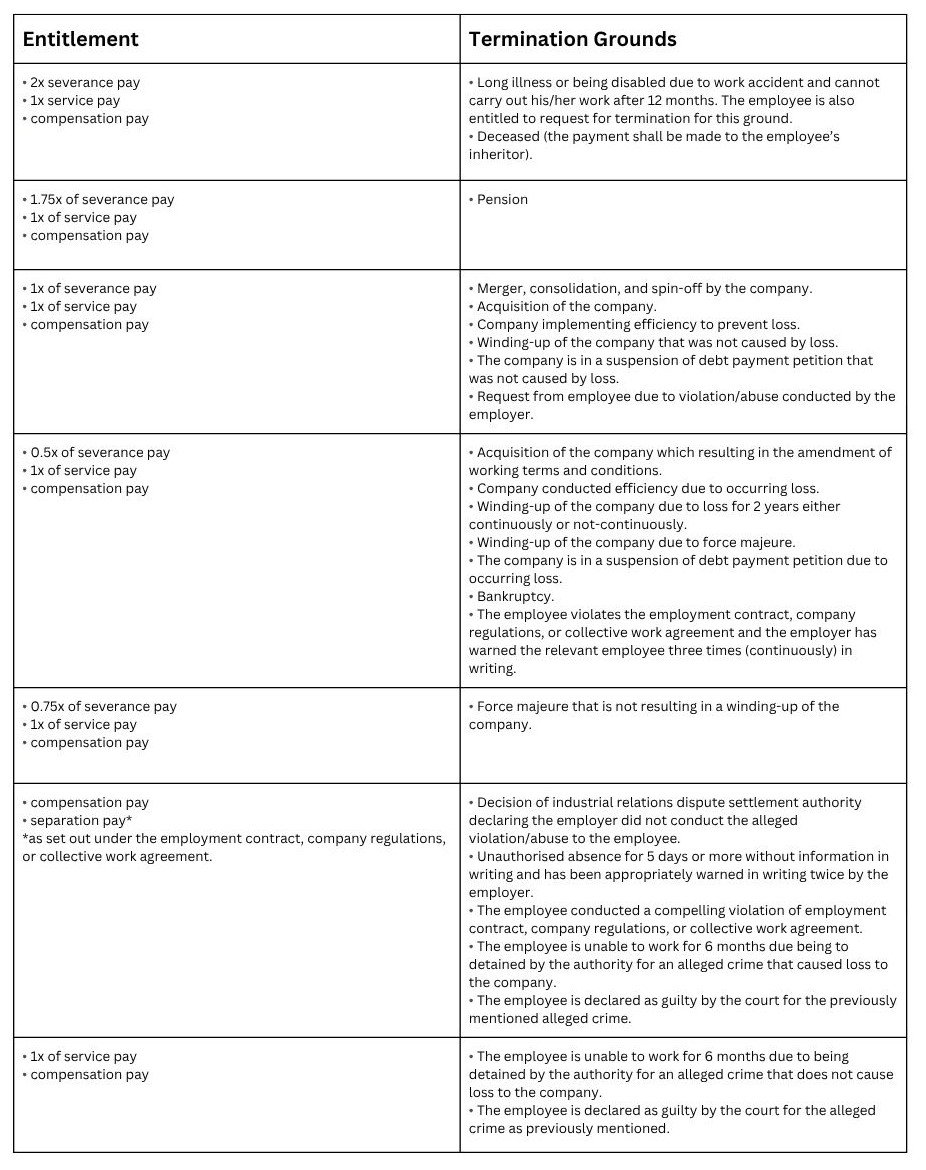
The calculation for severance pay, service pay and compensation pay based on the year of service remains unchanged as can be summarised as below.
Severance pay
Less than 1 year of service > 1 month's salary severance pay
1-2 years of service > 1 month's salary severance pay
2-3 years of service > 2 months' salary severance pay
3-4 years of service > 3 months' salary severance pay
4-5 years of service > 4 months' salary severance pay
5-6 years of service > 5 months' salary severance pay
6-7 years of service > 6 months' salary severance pay
7-8 years of service > 7 months' salary severance pay
More than 8 years of service > 8 months' salary severance pay
Service Pay
3-6 years of service > 2 months' salary service pay
6-9 years of service > 3 months' salary service pay
9-12 years of service > 4 months' salary service pay
12-15 years of service > 5 months' salary service pay
15-18 years of service > 6 months' salary service pay
18-21 years of service > 7 months' salary service pay
21-24 years of service > 8 months' salary service pay
More than 24 years of service > 10 months' salary service pay
The calculation of compensation pay covers any other entitlements governed under the employment contract, such as untaken annual leave, separation pay and others as relevant.
Practical approach to termination
In practice, where an employee violates a company regulation, CLA, employment contract or labour law, the employer will usually issue three consecutive warnings. If the violation qualifies as serious, the employer may immediately terminate the employee.
In most cases, an employer will seek the employee’s voluntary resignation through a ‘golden parachute’, which gives the employee compensation greater than the statutory minimum in exchange for their resignation. This avoids the time-consuming and expensive process of applying for approval of the termination.
Once the parties have resolved the termination issue and agreed to a settlement, they will then enter into a settlement agreement, which must be drawn up in the Indonesian language and registered with the Labour Court in order to be valid and binding.
Indonesia regulates personal data protection under Law No. 27 of 2022 regarding Personal Data Protection (the PDP Law). In the employment context, an employer becomes a personal data controller in relation to employees’ personal data, although in some arrangement it may also act as a personal data processor depending on the role it performs in a particular processing activity. As controller, the employer is responsible for ensuring that the processing of employees’ personal data complies with the PDP Law and that appropriate safeguard are in place to protect such data.
A brief summary of the key provisions of the PDP Law is set out herein.
Definition and types of personal data
PDP Law defines personal data as ‘any data regarding an identified person or a person that can be identified either individually or in combination with other information, directly or indirectly, by using electronic and/or non-electronic systems’. Personal data is further categorized into general and specific personal data. General data would cover information which are generic in nature and would often be listed in the Indonesian identify card, such as a person’s name, gender, nationality, religion and marital status. Specific personal data includes data such as medical information, biometrics, genetics, criminal records, child data, and/or personal financial data. The key distinction between the two types of personal data would relate to the degree of their risks and requirements that must be fulfilled with respect to processing these two types of personal data – which is further discussed below in the section regarding data protection impact assessment and data protection officer.
Scope and applicability
The PDP Law provides a far-reaching scope for its applicability where it includes any individuals, corporations, public institutions (e.g., executive, legislative and judicative branch that relates to the state operation) and international institutions that controls and/or processes personal data. In this regard, the PDP Law confirms its extra-territorial scope as it would also cover any personal data of Indonesian subjects outside of Indonesia either being processed in Indonesia or outside of Indonesia provided that such processing have legal impact in Indonesia.
The PDP Law does not, however, apply to individuals who processes personal data for personal or household use.
Rights of personal data subjects
The PDP Law stipulates that personal data subjects have the right to obtain information concerning the identity and accountability of the party that requests or collects its personal data as well as to know the purpose and usage of such request or collection. Personal data subjects may further alter, update, or change its personal data as well as end, terminate and/or erase its personal data. However, these rights are subject to exemptions when facing the interest of national security and defence, law enforcement, public interest in relation to state operation, supervisory activities by financial/monetary authority in relation to state operation or statistic and scientific research.
Controller and processor of personal data
PDP Law further specifies two subjects with two separate functions and are responsible for personal data, being: (i) Controller, any party (including individuals, public bodies and international organisations) who determines the purpose and controls the processing of personal data; and (ii) Processor, any party who processes personal data.
The distinction of Controller and Processor would be relevant in their respective obligations, liabilities and compliance requirements. Businesses would need to be aware of their respective status in any personal data processing activity.
Primarily, a Controller would need to determine the purpose of data processing based on lawful grounds and a Processor must conduct its affairs as directed by the Controller. In principle, the Controller is responsible for the processing of personal data by the Processor. However, in the event of a breach of the Controller’s directive, the Processor will be liable for such processing of personal data.
Lawful grounds for processing personal data
The processing of personal data covers any use of personal data, such as collection, management, analysis, storage, revision, updating, display, announcement, transfer, dissemination, disclosure, deletion and termination of any personal data.
Prior to the PDP Law, consent was the primary ground for processing personal data. The PDP Law maintains that requirement of consent, which has to be express either in writing or recorded (either electronically or manually). In addition to consent, the PDP Law recognises other lawful grounds for processing personal data, namely for (i) fulfilment of contractual obligation, (ii) fulfilment of legal obligation of the Controller, (iii) protection of vital interest of the data subject, (iv) conduct of duty for public interest, public service or lawful authority of the Controller as well as (v) the fulfilment of other lawful interest(s).
Data protection officer and impact assessment
The PDP Law requires the appointment of a data protection officer (DPO) and the implementation of a data protection impact assessment (DPIA). Businesses should appoint a DPO whenever personal data is processed for public interest, any systemic monitoring of personal data in a large scale and any large scale processing of specific and/or crime related personal data. A DPO has the duty to advise on data privacy requirements and compliance – including the mitigation of any data privacy breach. In particular, the DPO would need to advise on the implementation of DPIA and act as the data privacy liaison officer in the company (whether the company is acting as a Controller or Processor). The PDP Law does not stipulate the requirement for a DPO to be certified. However, the qualifications for appointing a DPO include assessment on a person’s professionalism, legal knowledge and capabilities in the area of data privacy practice.
A DPIA should be implemented for any ‘high risk’ processing of personal data, such as when there is any processing of personal data involving (i) specific personal data, (ii) automatic decision making, (iii) any large scale processing, (iv) systemic evaluation, scoring and monitoring, (v) combination of certain data, (vi) use of new technology, and/or (vii) the limiting of the rights of data subjects.
It must be noted that the PDP Law does not provide further elucidation of each of the above conditions. For example, it is not clear what would constitute as large scale data processing. We expect that further elucidations and requirements on DPIA and DPO would be addressed in implementing regulations of the PDP Law.
Notification for data breach
In the event of a failure to protect personal data, the controller must provide a written notification no later than 3 x 24 hours to the affected personal data subjects and the relevant institution/government authority. The notification must at least set out: (i) the personal data that was compromised; (ii) when and how the breach occurred; and (iii) the mitigation and recovery measures taken by the controller. In certain cases, a public announcement may also be required.
Manpower Social Security Scheme
Employers are required to register their employees with Indonesia’s national social security system (known as BPJS). BPJS has two programs: Health BPJS and Employment BPJS. Indonesian citizens and all residents of Indonesia, including expatriate employees who work at least six months of the year in Indonesia, are required to join this program.
Through the Employment BPJS program, employers and employees make mandatory monthly contributions into the following programs:
Work and occupational hazard - The monthly contribution is paid by the employer and ranges between 0.24% and 1.74% of an employee’s gross monthly salary.
Old age - The monthly contribution is 5.7% of an employee’s gross monthly salary, of which 3.7% is paid by the employer and 2% by the employee.
Pension - The monthly contribution is 3% of an employee’s gross monthly salary, with 2% paid by the employer and 1% by the employee.
Death - The monthly contribution is paid by the employer in the amount of 0.3% of the employee’s gross monthly salary.
Job Loss Security - It forms part of the current wage-recipient coverage structure, with funding coming from the central government and recomposition of certain existing contributions rather than a fresh employee deduction.
Health Social Security Program
Under the Health BPJS program, a mandatory monthly contribution of 5% of an employee’s gross monthly salary must be made – with 4% paid by the employer and 1% paid by the employee. However, in the case of government institutions and public servants, 3% is paid by the employer and 2% is paid by the employee.
An employer failing to comply with the BPJS registration obligation may be subject to administrative sanctions, including warning letters and fines, and no longer being eligible to receive certain public services.
The Indonesian Constitution (UUD 1945) establishes the fundamental principle that:
all citizens are equal before the law and government, and
every citizen has the right to work and to earn a decent livelihood.
These principals are reflected in the Manpower Law, which prohibits discriminatory treatment in employment.
The Manpower Law states that termination of employment is not permitted where it is based on the ideology, religion, political inclination, ethnic group, race, social group, gender, physical condition, or marital status of the employee. Further, GR 36/2021 states that in determining an employee’s wage, the employer may not discriminate between workers who perform work of equal value.
To ensure the protection of employees’ rights and prevent discrimination, Law No. 21 of 1999 ratified International Labour Organisation (ILO) Convention No. 111 on Discrimination in Respect of Employment and Occupation, while Law No. 80 of 1957 ratified ILO Convention No. 100 on Equal Remuneration for Men and Women for Work of Equal Value.
Indonesian law does not yet contain a single, comprehensive statutory framework specifically addressing workplace harassment or bullying. However, such conduct may still give rise to liability under general employment protections, company regulations/codes of conduct and criminal law.
There are various industry-specific workplace safety and health regulations, and the Manpower Law states that all employees should enjoy protection of their work safety and health, morality and decency, and treatment that is respectful of human dignity and religious values. Employers are required to provide these rights to their employees by implementing a workplace safety and health management system.
As a member of the International Labor Organisation (ILO), Indonesia has ratified the 2006 Promotional Framework for Occupational Safety and Health Convention, which is one of the ILO’s essential instruments for workplace safety and health. In 2012, Government Regulation No. 50 of 2012 was issued regarding Occupational Safety and Health (OSH) Management Systems, requiring employers to establish an OSH management system where they have at least 100 workers or where the work is potentially very hazardous. The MOM can impose administrative sanctions under the Manpower Law on any employer failing to implement such a system if required.
Industrial relations disputes in Indonesia commonly take one of four forms:
dispute over rights contained in employment agreements and company regulations;
dispute over interests;
dispute over employment termination;
dispute between unions at a company.
Bipartite Labour Dispute Resolution
In the event of a labour dispute, the first step taken to resolve the dispute is the holding of a bipartite meeting between the company and the employee/labour union concerned, at which the parties must make efforts to reach a settlement. If the parties can reach a settlement, they will sign a mutual agreement containing the terms of the settlement. The mutual agreement is then registered with the Labour Court. If the parties cannot reach a settlement, then the local labour office will offer the disputing parties an opportunity to settle through a tripartite process.
Tripartite Labour Dispute Resolution
Tripartite labour dispute resolution can take one of three forms:
Mediation by a mediator registered with the labour office.
Conciliation by a conciliator registered with the manpower authority at the district/city level.
Arbitration by an arbitrator appointed by the Minister of Manpower.
Similar to a bipartite meeting, if the mediation, conciliation or arbitration is successful, then the parties will sign a mutual agreement and then register it with the Labour Court. If the parties cannot settle their dispute through mediation or conciliation, then either party may refer the dispute to the Labour Court. In the case of arbitration, the arbitral award is final and binding, and may only be challenged before the Supreme Court on limited grounds.
Labour Court
The decision of a Labour Court may be appealed to the Supreme Court.
Indonesian law does not recognise an automatic transfer of employment upon a transfer of business (whether by way of share acquisition, asset transfer, merger, consolidation or spin-off).
Instead, the continuation of employment depends on:
the type of transaction, and
whether the employee agrees to continue employment
As a result, employment-related consequences must be carefully managed in any transaction involving Indonesian employees.
Share acquisition
In a share acquisition, the employing entity remains unchanged. Accordingly:
employment relationships continue automatically by operation of law
there is no termination of employment
existing employment terms and conditions remain binding
However, employees may in practice raise concerns (e.g. changes in management or business direction), which may need to be addressed from an industrial relations perspective.
Asset transfer
In an asset transfer or business transfer scenario:
employees do not automatically transfer to the buyer
the buyer must offer new employment, and
each employee must consent to the transfer
If an employee does not agree to transfer:
the seller must terminate the employment, and
statutory termination entitlements will apply under GR 35/2021
Merger, consolidation or spin-off
In the case of a merger, consolidation or spin-off, Indonesian law provides more structured outcomes.
If employees agree to continue employment:
employment continues with the surviving or receiving entity
existing terms should generally be maintained (or improved)
If employees refuse to continue employment:
termination will occur, and
the employee is entitled to statutory compensation
If the employer does not wish to retain employees post-transaction, termination will also occur with statutory entitlements. Typical entitlements (under GR 35/2021) include:
1x of severance pay
1x of service pay
compensation pay
Government Regulation No. 34 of 2021 (GR 34/2021) stipulates provisions for the hiring of foreign workers in Indonesia. The key employment permit for foreign worker is the Foreign Worker Utilisation Plan (Rencana Penggunaan Tenaga Kerja Asing, RPTKA).
GR 34/2021 allows for a foreign worker to be employed by 2 employers in the same role as:
director or commissioner; or
certain role in the vocational education and training sector, digital economy sector, and oil and gas sector for cooperation contract contractor (kontraktor kontrak kerja sama/KKKS), which details will be further regulated by implementing regulation in ministerial level,
provided that the first employer has given its approval for such arrangement.
Further, RPTKAs are now divided into four categories:
RPTKA for temporary work > Valid for a maximum of 6 months (Not extendable)
RPTKA for work more than 6 months > Valid for more than 6 months (Extendable)
RPTKA that is not eligible for non-tax state revenue > Valid for more than 6 months (Extendable)
RPTKA for Special Economic Zone (Kawasan Ekonomi Khusus) > Maximum of 5 years (Extenable)
The following foreign workers are exempted from the RPTKA requirement:
director or commissioner with a certain shares ownership, or shareholders in accordance with the applicable laws and regulations;
officers at the foreign country diplomatic and consular missions;
foreign workers required by the employer for the type of production activity being halted due to emergency situation, vocation, tech-based start-up company, business trip, and study for certain period of time.
In Constitutional Court Decision No. 168/PUU-XXI/2023, the Court indicated that:
the legislature should prepare a new standalone manpower law, separate from the Job Creation Law
The Court suggested a two-year timeframe from the decision date.
However:
this statement forms part of the obiter dictum, and
does not invalidate the current legal framework
As of early 2026, there are indications that the government has commenced drafting a new manpower law, although no formal timeline has been confirmed.
Contacts

Kresna Panggabean
Partner & Head of Office
TNB & Partners in association with Norton Rose Fulbright Australia

Jeremiah Purba
Senior Associate
TNB & Partners in association with Norton Rose Fulbright Australia

Salman Sembiring
Associate
TNB & Partners in association with Norton Rose Fulbright Australia
