Cross-border guide
Employment
Managing a global workforce requires navigating complex and frequently changing employment laws. Our cross-border guide outlines the key aspects of employment law across multiple jurisdictions, helping organizations understand their obligations and manage employment issues with confidence.
Jurisdictions
Brazil
Brazil
Argentina
The content of this guide summarizes the position as at August 2026.
Brazil
Some kind of longer intro text here to set the scene for the entire section, possibly drawing out some of the highlights from this region. Making a solid intro for the detail which follows below. Some kind of longer intro text here to set the scene for the entire section, possibly drawing out some of the highlights from this region. Making a solid intro for the detail which follows below.

Employment relationships in Brazil are generally governed by the Brazilian Consolidated Labor Statutes (“CLT”), associated laws, labor authorities’ regulations and collective bargaining instruments (“CBA”) entered into with unions. Employment relationships in certain industries, such as shipping and navigation, railways, banking and aeronautics, are subject to additional and specific legal regulation.
An employment status is determined by the factual conditions regarding how an individual works in practice. That said, CLT defines an employee as a person who provides "non-occasional" services to an employer, under the employer's control, in exchange for remuneration. Therefore, the main characteristics of an employment relationship are (i) services are controlled by the employer; (ii) services are performed personally by an individual; (iii) the individual’s engagement is ongoing and permanent.
One of the most relevant principles underlying conflict resolution in Brazil is the principle of the primacy of the reality of the facts, that is, in case there is a conflict between the facts and what was contractually agreed between the parties, facts will prevail. This means that even if contracts and policies point to the inexistence of employment features, facts may indicate the opposite.
Brazilian law establishes a set of minimum employment benefits that must be provided to all employees. These benefits apply regardless of the employer’s activity and the employee’s position. The minimum benefits are:
Salaries paid on a monthly basis. These cannot be lower than the minimum wage established by the Government as adjusted on an annual basis pursuant to inflation rates (in 2026 it corresponds to BRL1,621.00) or in the applicable collective bargaining agreement (“CBA”);
An additional “13th month salary” or Christmas bonus, equal to the value of one month’s salary, payable in two instalments: 50% up to November and 50% in December;
30-days paid vacation for each 12 months of service;
An additional payment equivalent to 1/3 of the employee’s normal rate of pay while the employee is on paid vacation;
One day off per week, preferably on Sundays; and
Additional contributions corresponding to 8% of the employee’s salary to be paid by the employer into a public trust fund called the Unemployment Guarantee Fund (Fundo de Garantia do Tempo de Serviço - “FGTS”). The employee may be entitled to withdraw from the FGTS in certain circumstances;
Unemployment compensation consists of temporary financial aid for registered employees who involuntarily lose their job (employees who resign or are terminated for cause are not entitled to such benefit);
Working under dangerous conditions (e.g. electricity, flammable or explosive materials) triggers the payment of a hazard payment of 30% over base salary;
Working under hazardous conditions, such as in a noisy environment, exposed to radiation, etc. triggers the payment of a risk payment at 10%, 20% or 40% over minimum wage (percentages vary according to actual risks); and
Transportation allowance can be provided to employees who commute by public transportation and opt to receive such benefit upon hiring. Companies can deduct up to 6% of the salary to cover this expense.
Any company with more than 20 employees must manage its employees’ work and rest hours. All hours in excess of 8 hours per day or 44 hours per week are considered overtime and must be compensated accordingly. The rate for payment of overtime is 1.5 times the regular hourly rate if worked during the week and 2 times the regular hourly rate if worked during weekends and holidays.
CLT provides for a limit of 2 overtime hours per day. Companies may establish (with each employee or collectively) a system pursuant to which hours worked in excess in one day may be offset against time-off in another day. There are specific rules in this regard under Brazilian law.
Moreover, where employees do not enjoy in full their meal breaks or a break in between shifts of at least 11 consecutive hours, they must receive overtime for the period they did not enjoy.
There are some exceptions to the requirement for overtime pay. For example: (a) employees whose role involves “external activities” - such as sales employees or those working from home, (b) certain senior employees, such as managers and officers, are generally not entitled to overtime pay, and (c) those working from home and who have been hired per “task” or “production”. There are also different overtime rules applying to different categories of employees, such as banking employees, school teachers and journalists.
Employers must pay social security contributions on its payroll. Applicable rates usually range between 26.8% and 28.8% depending on the core business (riskier employer activities command higher rates).
Employees must also pay their contributions to the Social Security Agency (“INSS”). These are withheld from their salaries at rates of 7.5% to 14% depending on their salaries.
Employees are also subject to personal income tax (IRPF) on their employment income, which must be withheld at source by the employer. There is no cap on personal income tax, and the applicable monthly withholding tax rates in 2026 are as follows:
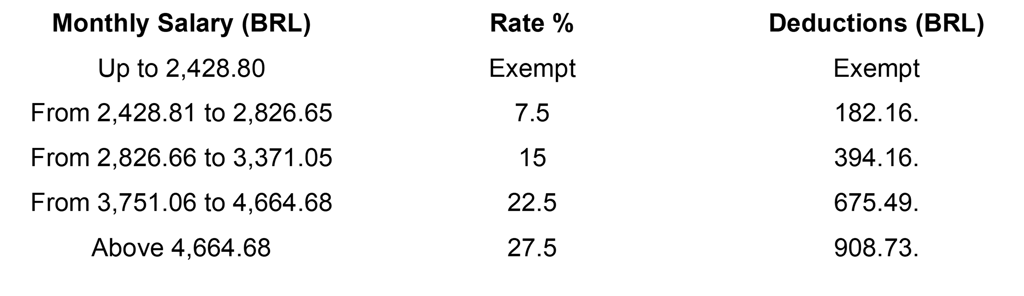
In addition, as from January 1, 2026, individuals earning monthly taxable income of up to BRL 5,000.00 are entitled to an additional withholding tax reduction mechanism. Under this rule, the withholding income tax is first calculated in accordance with the regular progressive tax table above and, thereafter, an additional monthly deduction of up to BRL 312.89 is applied, effectively reducing the withholding income tax to zero.
For individuals earning between BRL 5,000.01 and BRL 7,350.00 per month, a partial and gradually reduced withholding tax benefit applies. In such cases, the withholding income tax is first calculated under the regular progressive tax table and, subsequently, an additional deduction is granted according to the following formula: Tax Reduction = BRL 978.62 – (0.133145 × Monthly Income).
Accordingly, the amount resulting from the formula above must be deducted from the withholding income tax otherwise due under the regular progressive tax table.
Individuals earning more than BRL 7,350.00 per month are not entitled to this additional reduction mechanism, and the regular withholding income tax table applies in full.
An individual employment contract is any implied or express agreement relating to an employment relationship. There are no statutory requirements as to the form or content of individual employment contracts. The law only requires the basic employment information (name of the employer, the tax ID (CPF), position, base salary and the like) to be registered in the employees’ work card (the CTPS) and in the e-Social system, a digital bookkeeping tax, social security and labor obligations tool implemented in 2014 that connects employers with governmental authorities (e.g. Social Security Agency, Ministry of Labor and Social Security, Federal Revenue etc.) and shares employees’ information with the applicable authority.
Employment contracts must not provide conditions that conflict or are worse than the terms of labor law or, as a rule, any collective agreements that apply to the employment relationship.
Additional terms and conditions, especially those that are more likely to be updated from time to time (e.g. benefits) may be set out in specific policies, avoiding the need to amend employment agreements each time a condition is updated. Any benefit granted by an employer to its employees on an ongoing basis becomes an implied part of the employer’s employment contract with those employees.
An employer cannot unilaterally amend an employee’s employment contract. Statute provides that amendments to contractual terms and conditions require express agreement between the employer and the employee. Even amendments mutually agreed are considered null and void if made to the detriment of the employee.
In addition, there is a specific prohibition on reducing employees' pay, unless authorized under a CBA.
Employment relationships are usually for an indefinite term, but in some circumstances, they can be for a fixed term, provided that there is a justification and the term does not exceed two years (which can be renewed for a second term).
Moreover, as from the enactment of Law No. 13,467/2017 (the so-called “Labor Reform”), employers may hire intermittent workers. This type of arrangement is defined as the provision of non-continuous services with subordination (i.e. under the direct control and management of the employer). Under an intermittent schedule, the company can hire individuals to render services on an infrequent basis or in alternate periods of work and inactivity (to be determined by hours, days or months, regardless of the nature of the services) – this is similar to zero-hour contracts.
As a default rule, employment can be terminated without cause at any time upon a minimum thirty-day notice plus three extra days per year of work capped at ninety days. CBAs and employment contracts can provide additional notice periods. The notice can either be worked, i.e. the employee is notified and works throughout the notice period, or the employer can also pay the employee in lieu of the applicable notice period.
There are five different types of termination under Brazilian labor law: (i) termination by the company without cause; (ii) termination by the company with cause; (iii) termination by the employee without cause (resignation); (iv) termination by the employee with cause (constructive dismissal); and (v) termination by mutual agreement. Statutory severance packages will vary according to each of them, as follows:
Termination by the company without cause: As mentioned above, the employer can generally terminate an employment contract at any time and without any particular reason, by giving proper notice. It is not necessary (or usual) for the employer to explain the reason for the termination. In this type of termination, companies must pay the following severance package:
Outstanding salary;
All accrued and proportional vacation pay, plus one-third bonus in respect of vacation pay;
Proportional 13th month salary;
Payment in lieu of prior notice – if not worked; and
A 40% fine on top of the entire FGTS balance existing in the employee’s FGTS account (the employee is allowed to access and withdraw the full balance).
Termination by the company with cause: The employer can also dismiss the employee summarily, without notice, on specified grounds related to misconduct (article 482 of the CLT). The hypothesis that may constitute misconduct, for employment purposes, are as follows: (i) dishonesty, wrongdoing or lack of self-control; (ii) direct or indirect competition with the employer or with its activities; (iii) criminal conviction, except where the sentence is suspended; (iv) dereliction of duties; (v) habitual intoxication on duty; (vi) breach of business secrecy; (vii) acts of indiscipline or insubordination; (viii) abandonment of work; (ix) habitual gambling; (x) acts during work that damage the reputation or honor of another person, or cause physical injury to another person, except in legitimate self-defense or the defense of someone else; (xi) acts at any time that damage the reputation or honor of the employer or an organizational superior, or cause physical injury to such a person, except in legitimate self-defense or the defense of someone else; (x) loss of the qualification necessary for the exercise of a profession, as a result of the willful conduct of the employee; and (xi) acts detrimental to national security duly proved. Severance package will encompass:
Outstanding salary;
All accrued vacation pay, plus one-third bonus in respect of vacation pay;
Termination by the employee without cause (i.e. resignation): The resignation is a unilateral act that depends exclusively on the employee’s will. Resignations do not need to be approved or accepted by the company to be effective. However, in order to do so, employees shall submit a formal hand-written resignation letter. The employee must give notice of 30 days to the company. Otherwise, the corresponding salary may be deducted from the employee’s severance pay. In its own discretion, the company has the right to waive the notice period, in which case the resigning employee should cease his/her services with immediate effect. Such waiver results in the company paying the respective notice period salary along with the other severance amounts. Severance amounts will be:
Outstanding salary;
All accrued and proportional vacation pay, plus one-third bonus in respect of vacation pay; and;
Proportional 13th month salary.
Termination by the employee with cause (i.e. constructive dismissal): Employees may resign summarily (without notice) on specified grounds (article 483 of the CLT), such as the employer failing to meet its contractual obligations (e.g. lack of salary payment, demotion, services not established in the employment agreement etc.). The severance dues are the same as a termination without cause by the company. Note that, in this scenario, employees must request before courts the recognition of such a type of termination, and severance will be paid after a judicial decision in this regard is issued.
Termination by mutual agreement: This type of termination is an intermediate alternative between a resignation and a dismissal without cause. That is, while more generous than a resignation, it is more cost-effective than a dismissal without cause. Therefore, by conducting the termination as a mutual agreement the employee will benefit from a more generous severance payment and (partial) FGTS release. On the other hand, the company would incur in a higher amount of severance. In this sense, employees would be legally entitled to receive as a severance package:
Outstanding salary;
All accrued and proportional vacation pay, plus one-third bonus in respect of vacation pay;
Proportional 13th month salary;
Half the amount paid in lieu of the termination notice – if not worked; and
Half the FGTS fine on top of the entire balance existing at the employee’s FGTS account (the employee is allowed to access and withdraw up to 80% of the balance).
The deadline to pay severance is 10 days after the last day of work, and the employer must, within the same 10-day period, deliver all termination documents (including FGTS withdrawal and unemployment insurance forms). Missing this deadline gives rise to a penalty equal to one month of the employee’s salary, in addition to any amounts due.
It is not uncommon for companies to pay an additional severance package in specific circumstances and for specific employees. These packages usually consist of an additional period at company’s health insurance, outplacement payments, additional compensation, and bonuses, among others.
Exceptions to the general rules on employment termination are the cases where employees are entitled to temporary job protection, either as provided by law or under the applicable CBA.
Some examples of legally-mandated job protection are: (i) during pregnancy and for five months after birth; (ii) union leaders, from the moment they become candidates running for such role through one year after the term ends; (iii) workers’ representatives of the CIPA (In-house Commission for Prevention of Accidents), also from the moment they become candidates running for such role through one year after the term ends; and (iv) employees on sick leave, whose employments can only be terminated upon medical discharge.
CBAs usually provide for additional protection against termination. For instance, quite commonly CBAs prohibit the termination of employees who are close to retirement or for a short period after return from vacation or sick-leave unrelated to work.
Law No. 13,709/2018 known as the General Data Protection Law (Lei Geral de Proteção de Dados – “LGPD”) was published on August 15, 2018, and came into full effect in September 2020. This is the main normative instrument that deals with employees and candidates data protection.
The LGPD requires data controllers and processors to adopt security, technical and administrative measures to protect personal data from unauthorized access and accidental or unlawful destruction, loss, or modification.
Therefore, the handling of personal data faces certain limitation. That said, article 7 of LGPD sets forth ten cases that would authorize the processing of personal data, as follows:
upon consent of the data subject;
for the fulfillment of legal or regulatory obligations by the controlling person;
by the public administration, for the treatment and shared use of data necessary to carry out public policies set forth in laws and regulations or based on agreements, conventions or similar instruments, with due regard to the specific provisions;
for the conduction of studies by a research body, with the anonymization of personal data being guaranteed, whenever possible;
whenever necessary to enforce an agreement or preliminary procedures connected to an agreement to which the owner is a party, upon request from the owner of the data;
for the regular exercise of rights in judicial, administrative, or arbitration proceedings;
for the protection of the life or physical integrity of the owner or of a third party;
for the protection of health, in a procedure carried out by healthcare professionals or health surveillance entities;
whenever necessary to fulfill the legitimate interests of the controlling person or of third parties, except if the fundamental rights and freedoms of the owner that require the protection of the personal data prevail; or
for the protection of credit, including regarding the provisions of the relevant legislation.
Pursuant to the LGPD, ‘processing’ is any operation carried out with personal data, such as those regarding collection, production, receipt, classification, use, access, reproduction, transmission, distribution, filing, storage, elimination, evaluation or control of information, modification, communication, transfer, diffusion or extraction of the data.
Even if consent from the data subject is waived, the processing agents remain obliged to comply with the following principles provided under article 6 of the LGPD:
purpose: execution of the treatment for legitimate, specific and explicit purposes, informed to the owner, which may not be later treated in a manner that is incompatible with such purposes;
appropriateness: compatibility of the treatment with the purposes informed to the owner, according to the context of the treatment;
need: limitation of the treatment to the minimum necessary to achieve its purposes, with the use of pertinent and proportional data that is not excessive in relation to the purposes of the treatment;
free access: the guarantee, to the owner, of easy and free consultation regarding the form and duration of the treatment, as well as regarding the entirety of their personal data;
data quality: the guarantee, to the owner, that the data is accurate, clear, relevant and up-to-date, pursuant to the need and to achieve the purpose of the treatment thereof;
transparency: the guarantee, to the owner, of clear, accurate and easily accessible information on the conduct of the treatment and the respective treatment agents, in observance of trade and industry secrets;
safety: use of technical and administrative measures able to protect the personal data from unauthorized access and accidental or illicit events of destruction, loss, alteration, communication or disclosure;
prevention: adoption of measures to prevent damage due to the treatment of the personal data;
non-discrimination: impossibility of carrying out the treatment for illegal or abusive discrimination purposes;
liability and accountability: demonstration, by the agent, of the adoption of effective measures able to prove the observance and compliance with personal data protection rules, including the efficacy of these measures.
The legal grounds to process personal data shall be analyzed jointly with the principles mentioned above and with the cases of end of data processing set forth by law, namely: (i) verification that the purpose has been achieved or that the data have ceased to be necessary or pertinent to achieve the specific intended purpose; (ii) end of the treatment period; (iii) communication from the owner, including in the exercise of his or her right to revoke consent, protecting the public interest; (iv) or by determination of the Brazilian authority, when there is violation to the LGPD.
Personal data shall be eliminated at the end of their processing, within the scope and technical limits of the activities, but may be retained for the following purposes: (i) fulfilment of statutory or regulatory obligations by the controller; (ii) studies by research bodies, ensuring, whenever possible, the anonymization of personal data; (iii) transfer to a third party, to the extent that the data processing requirements set forth in the LGPD are fulfilled; or (iv) exclusive use by the controller, provided they may not be accessed by a third party, and to the extent that the data are anonymized.
As long as the employee’s consent is obtained, employers may access emails, documents and telephone records used by the employees to perform their labor tasks – provided that these are devices/equipment provided by the company i.e. not personal. Any monitoring should not be directed to a specific employee, in order to avoid allegations of discrimination.
The Brazilian Constitution prohibits discrimination on the basis of national origin, race, sex, color and age, among other characteristics.
Discrimination in employment is regulated by a statute (Law 9,029/95). This statute provides that an employer may not refuse to employ a person, and may not terminate the employment of a person, on the basis of certain characteristics, including sex, national origin, race, color, marital status, family situation, disability or rehabilitation, among others. The inclusion of the words “among others” in the statute gives judges the ability to determine other types of protected characteristics.
If an employee believes they have been dismissed for a discriminatory reason, they may sue the employer and seek either one of the following options: (a) reinstatement in the job and payment of all salary and benefits the employee would have received between termination and reinstatement (“front pay”); or (b) two times the amount the employee would have received as front pay. In addition, the employee can seek damages for non-economic loss due to emotional distress, defamation etc. Damages for non-economic loss are known in Brazil as “moral damages”.
Brazilian law also protects against sexual harassment. In addition to being unlawful under the anti-discrimination statute, and for providing just cause for termination of employment, sexual harassment is a crime punishable by imprisonment for one to two years, under article 216-A of the Brazilian Criminal Code. The Code defines sexual harassment as the use of someone’s authority to coerce or solicit sexual favors from others. However, courts and scholars read this definition to include not only quid pro quo sexual harassment, but also hostile work environment sexual harassment.
There is another type of unlawful harassment in Brazil known as “moral harassment”. This is a broad concept that includes hostile work environment harassment (without regard to sex), workplace bullying and intentional infliction of emotional distress. Employees who believe they have been subject to moral harassment may apply to the court for recognition of a constructive termination, so that they can claim severance pay and moral damages.
Since September 21, 2022 (Law No. 14,457/2022), employers must implement anti-harassment compliance measures: adopt internal policies and procedures, maintain confidential reporting channels, and provide at least annual training to prevent sexual harassment and other forms of workplace violence. The Internal Commission on Accident Prevention (“CIPA”) must participate in prevention initiatives and the dissemination of procedures. Employers should keep records (policies, trainings, attendance, investigations, and follow-up actions) to evidence compliance; non-compliance is subject to labor-inspection measures and administrative fines.
Since 2023, companies with 100 or more employees are required to publish, twice a year, a Pay Transparency Report disclosing anonymized salary data and remuneration criteria. Reports must be submitted through official Brazilian platforms (e-Social and Emprega Brasil) and published on the company’s website and social media. If unjustified pay gaps are identified, employers must implement a corrective Action Plan within 90 days, including diversity programs and training.
Non-compliance may result in fines of up to 3% of the payroll (capped at 100 minimum wages), and discriminatory cases may trigger penalties of ten times the adjusted salary, doubled in case of recurrence.
Workplace health and safety is regulated under both the CLT and Regulations Nos. 1 to 37 issued by Ministry of Labor and Social Security.
In general terms, employers are required to (i) observe and enforce workplace health and safety plans and other requirements; (ii) adopt preventive and corrective measures required under Ministry of Labor and Social Security Regulations; (iii) inform employees about potential occupational risks; (iv) establish internal procedures to prevent workplace injuries (which can be caused by accidents or workplace related illnesses); and (v) take measures to eliminate hazards and risks by supplying (and ensuring employees wear) personal protective equipment.
Some of the key features of laws relating to workplace health and safety in Brazil are:
Employers are required to implement a Risk Management Program (“PGR”): its purpose is to enable companies to identify, evaluate and subsequently control risks at the workplace, such as physical, chemical, biological, ergonomics and hazards;
Employers are required to implement an Occupational Health Medical Control Program (“PCMSO”): its purpose is to dedicate a doctor, a nurse or another health professional to screen and achieve early diagnosis of work-related health problems. The number and type of professionals required by each employer depends on the type of activity performed by the employer, its inherent risk, the number of employees and other elements. The PCMSO should generally require employees to undergo medical checks when they are hired, when their employment is terminated and annually during their employment; and
Employers are required to establish an Internal Commission on Accident Prevention (“CIPA”): this is a committee of elected employee and employer representatives who meet regularly to develop risk assessments, investigate incidents and suggest prevention measures. CIPA members representing the employees are protected against termination without cause.
Even if all the plans, policies and procedures above are in place, employees who are exposed to unsafe conditions at work are entitled to hazard pay at rates ranging from 10% to 40% of the minimum wage. Hazards are defined under regulation as anything that is harmful to one’s health. This includes excessive noise, heat, cold, pressure and vibration. Radiation, certain chemicals and biological agents are also classified as hazards.
Brazilian law also provides additional pay for employees working in dangerous conditions. This includes employees who are exposed to flammables, explosives or electricity in the performance of their role. Employees working in dangerous conditions are entitled to a risk pay at 30% of their base salaries.
It is the legal obligation of all companies, under penalty of being held civilly and/or criminally liable for any occupational accidents or diseases to: (i) comply and cause compliance with health and safety rules; (ii) instruct its employees as to any precautions to be taken in order to avoid occupational accidents or diseases; (iii) provide equipment for collective and individual protection; (iv) provide detailed information to their employees regarding risks to which they are subject, among other preventive measures.
Ministry of Labor and Social Security conducts audits of employers to ensure compliance with these rules. Penalties are imposed in the case of a breach.
As of May 2025 — with full effectiveness by May 2026 — companies are required to identify and manage psychosocial risks (such as stress, harassment, and work overload), integrating preventive measures, training, and compliance documentation into the PGR and PCMSO. Management is responsible for implementing, documenting, and periodically reviewing psychosocial risk prevention and mitigation measures, as well as maintaining adequate records and supporting documentation to demonstrate compliance with occupational health and safety obligations.
In election years, political/electoral harassment has increasingly been treated by Brazilian labor authorities as a psychosocial risk factor and a prohibited form of workplace violence for purposes of NR-1 compliance. In this context, companies are expected to: (i) include express prohibitions against political/electoral harassment in their internal policies, codes of conduct, and compliance guidelines; (ii) maintain confidential reporting channels for receiving, handling, and investigating complaints; (iii) provide periodic training to managers and employees regarding prohibited conduct and available reporting mechanisms; and (iv) demonstrate engagement from senior management in implementing anti-harassment measures and psychosocial risk prevention initiatives.
Recent amendments introduced by Law No. 15,377/2026 reinforced the importance of preventive health initiatives in the workplace, including awareness measures related to vaccination and preventive medical care. In this context, companies may disseminate, through internal communication channels (including email and intranet), official information and awareness materials issued by public health authorities regarding vaccination campaigns and other preventive health measures, maintaining appropriate records of such communications. The Internal Commission for Accident and Harassment Prevention (CIPA) may support awareness efforts and record related discussions in meeting minutes.
There are unions in Brazil representing employees, but also unions representing employers. Unions representing employers are organized by industry (banks, automotive, mining, etc.) and these industries also have counterpart unions representing the employees.
In Brazil, although no one is legally required to affiliate or associate with a union (i.e. to become unionized), employers and employees are automatically under a certain union classification.
Unions are defined by categories: the economic category is related to the employer’s activities and the professional category is related to the employees’ activities (normally a mirror image of the employers’ union within some activity, or a profession). Unions’ structure in Brazil also provides for a form of monopoly: as a rule, there cannot be more than one union representing a business or professional activity within the same local (municipality, city etc.).
Unions usually negotiate and enter into an annual collective bargaining agreement. The CBA will regulate labor conditions such as duration of the workday, overtime rates, protections from termination, salary raises and the like. As of the Labor Reform, certain terms and conditions provided under labor statutes can be contracted around via CBAs. The terms of these agreements apply to all employees, regardless of their position and whether or not they are a member of the union.
In 2023, the Brazilian Supreme Court (“STF”) reinforced the validity of collective bargaining arrangements that limit or supersede statutory rules on rights available for negotiation, strengthening deference to collective autonomy (Theme 1,046).
According to Brazilian law (i) a change to a company’s legal structure has no effect over the company’s employees and their vested rights, and (ii) a change to a company’s ownership does not trigger termination of employment or alter the terms of employment for existing employees.
As a result, corporate reorganizations and transactions do not affect the employee benefit plans and, especially, the vesting of employee entitlements under such plans. No severance is payable as a result of corporate transactions or reorganizations, and employees, unions and other worker’s representatives are not required to consent to corporate transactions or reorganizations.
In an M&A transaction, the buyer of a company will become entirely liable for the company’s existing employment liabilities. This concept is known as labor successor liability. Appropriate indemnification provisions and careful determination of employment liabilities is therefore critical in each M&A transaction.
Brazilian law adopts a joint-employer concept known as economic group liability. Whenever two or more companies are under the control of the same parent company, or they share the same shareholders at some upper level of the corporate structure, all these companies are considered joint-employers.
The concept of joint-employers has two important consequences: (a) employees can be transferred back and forth within the group, but (b) all such companies are jointly and severally liable for employee benefits, severance pay and labor claims.
Under Brazilian law, joint and several liability means that any of the joint-employers can be required to pay in full the award, without any limitation and regardless of the size of their investment. The law, however, provides each of the employers with a right of recourse against the other joint-employers.
The hiring of a foreigner to work in Brazil requires the filing of a formal proceeding with the Ministry of Justice and Public Security, in order to ensure the necessary authorization for the foreigner to work freely in Brazil. This document must be requested by the company interested in hiring a foreigner to work in Brazil and must be requested from the General Immigration Coordination (CGIg), an agency of the Ministry of Labor and Social Security responsible for immigration matters.
The foreigner should also have a tax ID (CPF) and have a work card (CTPS). Companies are not obliged to provide those, but can assist in the process.
Apart from that, the hiring of foreigners works like any other hiring. The main differences concern (i) the documentation requested at the time of hiring the foreigner (e.g. temporary visa, a residence permit and also work permit), and (ii) the proportionality of the number of foreigners in a company, which cannot exceed 1/3 of the company's employees (i.e. 2/3 must be of Brazilian nationals).
Foreigners' overall rights are protected both by the Brazilian Federal Constitution and by Conventions No. 97 and No. 111 of the ILO and the Mercosur Treaty, which prohibit discrimination against these workers on grounds of nationality. After hiring, all rules applicable to national workers will apply to foreign workers.
Upon expiration of the visa, early termination of the fixed-term employment contract or resignation by the foreign employee, the company must inform the Ministry of Justice and Public Security which will inform the Federal Police so that their immigration status is updated. Employers are obliged to support the costs with repatriation (tickets) - employers may agree on certain additional benefits at their discretion.
Remote work
Telework has been originally added to the CLT upon enactment of the Labor Overhaul – until then, the law was silent on the rules on and impacts of such an arrangement, and it was up to employers to set their own policies. Rules on telework have been updated in September 2022 by means of Law No. 14,442/2022 (the “Telework Law”).
Said law amends the chapter of the CLT regulating telework. Firstly, it changed the legal definition of telework by establishing that: (i) telework (or remote work) is the work carried out, predominantly or not, outside the employer's premises, regardless if employees are required to be at the employer’s premises; and (ii) there are two types of teleworkers i.e. those hired per “task” or “production” will be exempt of time-tracking, and those hired per schedule, who would be non-exempt of time-tracking.
Until Law No. 14,442/2022, telework consisted of any work carried out predominantly outside the employer's premises (i.e. at least 3x per week from home) with sporadic requests to be present at the company’s premises would not disqualify. All employees on a telework model would be exempt of time-tracking.
In a nutshell: employees hired by “schedule” i.e. to work under specific time arrangements (e.g. for 6 or 8 hours a day) would have their working hours tracked normally (for employers counting on more than 20 employees) and they would, as a general rule, be entitled to overtime, unless other exemption applies.
Employers must give express guidelines on ergonomics, health and safety for employees to observe at home – and employees must sign a term acknowledging that they are aware of such guidelines. Employers remain responsible for ensuring a safe and healthy workplace even if services are rendered from employees’ homes, and such guidelines (or policies) will act as evidence that all due care was taken in that regard.
Contracting through legal entities (pejotização)
While outsourcing is permitted by law for both core and non‑core activities, Brazilian labor courts often reclassify individuals rendering services under the company’s direction and control as employees.
The Supreme Court (STF), however, has adopted a more liberal stance, recognizing greater freedom — particularly for highly qualified professionals — to structure work models and compensation, including outsourcing arrangements (leading precedent on outsourcing: Theme 725).
Contractors invoicing through their own entities are not entitled to statutory employment benefits and typically face a lighter tax burden, whereas employees have statutory protections but higher associated labor and tax costs. If contractors effectively work like employees — providing personal, non‑replaceable services under supervision, following fixed schedules, and receiving regular monthly payments — key risks include: (i) labor claims for reclassification and related benefits (including overtime and severance), brought individually, by unions, or by the Labor Prosecutor’s Office; (ii) labor inspections and audits with cumulative fines; and (iii) tax and social security assessments seeking allegedly unpaid contributions from either party.
In 2025, in light of conflicting case law, the STF admitted Theme 1,389 (ARE 1,532,603) need to harmonize precedents on contracting versus fraud, ordered a nationwide stay of related cases, and held a public hearing on October 6, 2025. The merits judgment remains pending as of December 2025.
Contacts